
April 23, 2026
Speech in Bloom
You read the books, you watched the milestone charts, and still something felt a little different. Maybe your child says full phrases from their favorite show instead of answering a direct question. Maybe they repeat lines from books or movies in moments that seem unrelated to what is happening around them. Maybe their language feels script-like, almost as if it is borrowed from somewhere else. If any of this feels familiar, your child may be a gestalt language processor, and that is worth understanding more deeply.
At Speech in Bloom, we work with children across Brooklyn and Manhattan whose communication styles do not always fit the standard developmental mold, and we believe that understanding how your child processes language is one of the most powerful things a family can do. Our therapists are trained in approaches designed specifically for gestalt language processors, and we bring that expertise directly to your home or your child's school.
In this article, we will look into what gestalt language processing is, what it looks like in real life, how it unfolds across developmental stages, and what families can do to support a gestalt language processor at home and in therapy.
Gestalt language processing is a style of language acquisition in which a child learns language in whole chunks or phrases rather than building communication word by word. The term "gestalt" comes from a German word meaning "whole" or "unified form," and it describes the way these children absorb and use language: as complete units of meaning rather than individual parts assembled together.
Most of us are familiar with the analytic language learning model, where children learn single words first, then combine them into two-word phrases, then expand into sentences. Gestalt language development follows a different path. A gestalt language processor may begin by echoing full phrases, songs, or lines from shows, and over time, gradually break those chunks apart into more flexible, self-generated language.
This distinction matters because gestalt language processing is not a disorder or a delay in the traditional sense. It is a different but recognized way that some children naturally acquire language. Recognizing this can shift how families and therapists approach communication support in a meaningful way.
For parents, gestalt language processing often shows up as echolalia, the repetition of words or phrases heard elsewhere. A child might say "time to go, time to go" every time they feel anxious, not because they are mimicking randomly, but because that phrase carries emotional meaning connected to an experience where they first heard it.
Gestalt language processing examples can also include a child who greets people with a line from a cartoon, uses a phrase from a storybook to express a need, or strings together familiar scripts during play. These are not empty repetitions. They are a child's best available communication tools, and they deserve to be treated as such.

Understanding gestalt language development means understanding that it moves through a natural progression. Researcher Marge Blanc, building on the foundational work of Ann Peters, described this in a framework that many speech-language pathologists now use with gestalt language processors.
In the earliest stage, a gestalt language processor uses whole, unanalyzed chunks of language, direct quotes from videos, songs, books, or conversations. Echolalia in toddlers is one of the most common ways this stage presents. The scripts themselves are meaningful, and many serve a communicative purpose even if that purpose is not immediately obvious to a listener.
In stage two, children begin to modify the scripts they use. They may change a pronoun, swap a word, or combine parts of two familiar phrases. This is a meaningful developmental shift, showing that the child is beginning to analyze and break apart their stored language chunks.
By stage three, a gestalt language processor is isolating smaller units from their original scripts. Single words and short phrases start to emerge as more independent communication tools.
Stage four brings the ability to combine isolated units into new, self-generated sentences. Communication becomes more flexible and spontaneous, and many children reach this stage with consistent support and a therapeutic approach that honors how they learn.
One of the questions we hear most often is whether echolalia is something to be concerned about. The honest answer is that context matters enormously. Echolalia in toddlers is common in gestalt language development, and in many cases it is purposeful, communicative, and a sign that language is actively developing.
Immediate echolalia, where a child repeats something just said to them, is different from delayed echolalia, where scripts are used from memory, sometimes hours or days later. Both can be part of gestalt language development and both deserve thoughtful, individualized support. You can read more about early communication patterns in our post on Signs of Speech Delay.

For a gestalt language processor, scripts are not a habit to break. They are a language system to build from. These children often have strong emotional associations with the phrases they use. A line from a beloved movie may express comfort, excitement, or distress because the emotional context of when it was first heard is embedded in how the child stores it.
The most effective approach acknowledges scripts as communication, responds to their meaning, and creates gentle opportunities for the child to expand and modify them over time. Our therapists are trained to do exactly this, using play-based, child-led sessions that meet each child where they are. To learn more about how we work, visit Our Approach.
Families play a central role in supporting a gestalt language processor, and many of the most helpful strategies fit naturally into daily life.
Rather than redirecting scripts, try responding to the meaning behind what your child says. If they use a phrase from a show when they seem upset, acknowledge the feeling. If they use a script to initiate play, join in. Responding to the intent behind language, rather than the form, keeps communication feeling safe and builds trust over time.
Because gestalt language processors learn in whole phrases, modeling language in natural chunks can be more accessible than breaking everything into single words. Narrating daily activities in short phrases, "time for breakfast," "let's get your shoes," gives your child rich material to work with.
If your child is working with a speech-language pathologist, staying connected to what happens in sessions makes a meaningful difference. Our therapists provide home practice guidance after each phase of therapy, and when your child is seen at school, we communicate directly with caregivers. Speech therapy at home is most powerful when families feel informed and involved.
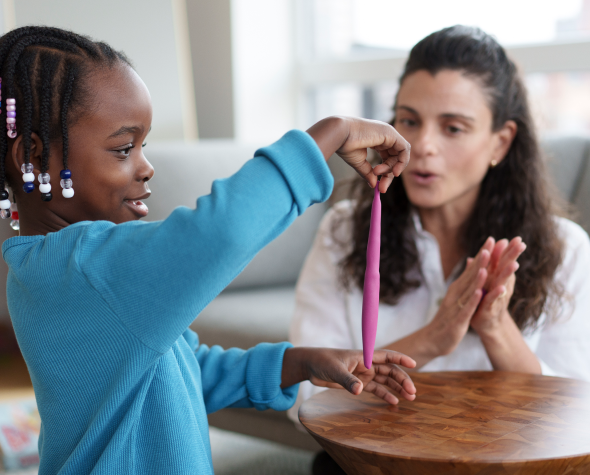
Our team includes speech-language pathologists with specialized training in gestalt language processing and Natural Language Acquisition frameworks. Sessions are play-based and child-led. We follow each child's scripts with curiosity, respond to their communicative intent, and create low-pressure opportunities for language to expand naturally.
We also look at the full picture of your child's development. Our intake process asks about communication patterns, sensory responses, eating, sleeping, and behavior, because these areas are often interconnected. Therapy plans are built around the whole child. You can see the full range of what we offer on our Services page.
We serve families across Brooklyn, including Park Slope, DUMBO, Brooklyn Heights, Carroll Gardens, Cobble Hill, Clinton Hill, Prospect Heights, Crown Heights, Fort Greene, Williamsburg, and Greenpoint, as well as Manhattan neighborhoods including the Upper West Side, Upper East Side, Chelsea, and West Village. We offer a complimentary consultation call as a low-pressure first step for any family with questions.
The phrase "echolalia treatment" can be a little misleading, because the goal of working with a gestalt language processor is not to eliminate echolalia. Echolalia is a stage of development to be supported and built upon, not a problem to be fixed.
A supportive approach focuses on acknowledging scripts as communication, identifying the function and meaning behind each script, and creating opportunities for the child to modify, combine, and expand their language. This is meaningfully different from approaches that suppress or replace scripts, and clinical experience increasingly supports honoring a gestalt language processor's natural learning style as the more effective path forward.

Gestalt language processing is a reminder that children do not all take the same road to communication, and that is not something to worry about. For gestalt language processors, scripts are not obstacles. They are the raw material of language development.
Understanding your child's communication style, and finding a therapist who genuinely understands it too, changes the entire experience of supporting their growth. At Speech in Bloom, our team brings clinical expertise and genuine warmth to every family, meeting each child where they are and building from there. Reach out to schedule a complimentary consultation call whenever you are ready.
Gestalt language processing is a way some children naturally learn language by absorbing whole phrases and scripts first, rather than building communication one word at a time. Over time, these children gradually break down their scripts into smaller, more flexible language.
Echolalia is one of the most visible signs of gestalt language development, but they are not the same thing. Echolalia refers to the repetition of heard language, while gestalt language processing describes the broader learning style that makes echolalia purposeful and developmental rather than random.
There are four recognized stages. Children begin by using whole, unanalyzed scripts, then gradually modify and combine them, isolate smaller units, and eventually produce flexible, original language. Each stage represents meaningful developmental progress.
Families may notice their child using lines from shows, songs, or books in daily communication. They might use a phrase from a movie to express a feeling, or repeat a line from a story during play. These are often purposeful communications, not meaningless repetition.
Patterns consistent with gestalt language development are often noticed in toddlers and preschool-aged children, though they can be identified at various ages. A consultation with a speech-language pathologist is a helpful next step if you have noticed your child communicating through scripts or phrases.
Not every gestalt language processor requires formal therapy, but many families find that working with a trained speech-language pathologist helps them understand their child's communication style and support it more effectively at home and at school.
Gestalt language processing is a different learning style, not necessarily a delay. A child may have a rich expressive repertoire of scripts while still being a gestalt language processor. A thorough evaluation by a speech-language pathologist is the best way to understand your child's individual profile.
Disclaimer:
The information shared here is intended to educate and empower families, not to replace individualized clinical guidance. Every child's developmental profile is unique. If you have questions about your child's communication or feeding, we welcome you to connect with our team for a personalized conversation.
Sources:
Speech and feeding therapy for children and families in Brooklyn and Manhattan
ContactStart your child’s speech and feeding therapy journey today. Reach out to schedule a complimentary phone consultation.
Let’s Talk