
March 24, 2026
Mealtimes are supposed to feel warm and connected, giving your baby a chance to slow down and enjoy a moment with you. But for some families, the dining room table can feel like the most stressful place in the house. If your child eats only a small handful of foods, gags at certain textures, refuses to try anything new, or becomes distressed before meals even begin, it’s okay to seek out support.
Feeding challenges are deeply personal, and they ripple across the whole family. At Speech in Bloom, our feeding therapy services are grounded in a gentle, child-centered approach. We don't just look at what your child is eating. We look into why they’re reacting the way they are and build from there. Our goal is to help make mealtimes feel a little more like they were always meant to.
So, what is feeding therapy? This article explains what it is, who it can help, and which approaches tend to be most successful.
Feeding therapy is a specialized clinical service that helps children build the physical, sensory, and behavioral skills needed for safe, comfortable, and functional eating. It goes beyond typical picky eating to address the underlying challenges that make it genuinely difficult for a child to eat age-appropriate foods or maintain proper nutrition.
Speech-language pathologists (SLPs) are the primary providers of pediatric feeding therapy, and may collaborate with physical and occupational therapists, physicians, psychologists, and other specialists as part of an interdisciplinary team (American Speech-Language-Hearing Association, n.d.). A comprehensive evaluation typically looks at oral motor coordination, chewing and swallowing function, sensory responses to food, medical history, and the child's relationship with eating overall.
Feeding challenges in children are more common than many families realize. Pediatric dysphagia is estimated to affect about 25% of typically developing children and up to 80% of children with developmental disorders, with prevalence continuing to rise as more children survive preterm birth and childhood disease (Malandraki & Arkenberg, 2021). Recognizing the conditions and situations where feeding therapy is most helpful can help families identify when feeding difficulties go beyond typical developmental phases.
Some children have difficulty forming a proper seal around a bottle or utensil, managing different food textures, or coordinating the complex movements required for chewing and swallowing. These oral motor delays may make early feeding challenging, and therapy can help build the physical foundation for safer, more functional eating.
Dysphagia, or difficulty swallowing, can pose real safety risks, including choking and silent aspiration. SLPs usually address these challenges through positioning strategies, texture modifications, and approaches that support safer swallowing patterns. Interprofessional collaboration is considered best practice for children with complex swallowing needs.
Some children experience heightened responses to food textures, temperatures, smells, or appearances, and these sensitivities are genuine, not behavioral. Children with sensory feeding challenges often limit food variety to avoid discomfort, which may lead to nutritional concerns and mealtime stress. Feeding therapy respects this discomfort while creating gentle pathways toward greater food acceptance.
Many children with autism spectrum disorder (ASD) experience feeding challenges connected to sensory processing differences, rigid food preferences, or difficulty with transitions. Eating disturbances such as food refusal are also more common in autistic children, with prevalence estimates ranging from 51% to 89% (Narzisi et al., 2021). Therapy adapted for children on the spectrum often incorporates visual supports, predictable routines, and sensory-friendly approaches that honor each child's unique processing style while gradually expanding their comfort and food variety.
Children who have had oral surgeries, extended hospitalizations, or tube feeding may develop oral aversions or lose eating skills during recovery. Research on tube-dependent children with oral aversion found that interdisciplinary feeding therapy improved food acceptance and maladaptive mealtime behaviors while lowering tube use during treatment (Bandstra et al., 2020). Feeding therapy helps rebuild positive associations with oral eating and supports the transition back to functional mealtimes.
Certain patterns suggest it may be time to consult a feeding therapist. While many eating preferences are developmentally normal, these specific challenges often have underlying sensory, motor, or medical roots that may benefit from professional support.
Mealtime Stress And Feeding Refusal: Some children consistently refuse to eat, turn away from food, or become highly distressed at mealtimes. This pattern often develops from discomfort during eating, sensory overwhelm, or negative feeding experiences that create lasting anxiety. Feeding therapy works to repair the relationship with food and restore calmer, more connected mealtimes for the whole family.
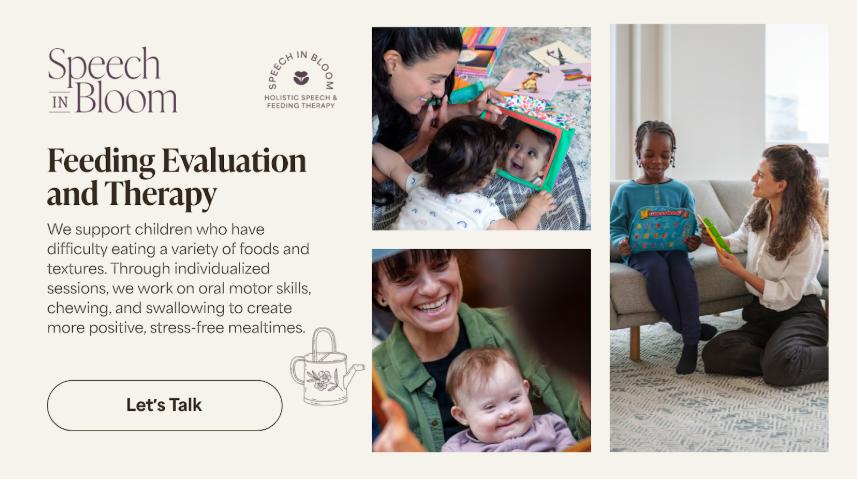
Effective feeding therapy draws on a range of evidence-informed approaches, always individualized to your child's specific profile and needs.
Play-based feeding therapy invites children to interact with food through non-threatening, low-pressure activities, such as sorting foods by color, testing out new textures through touch, or building with crackers before tasting them. By removing the expectation to eat, these experiences help children feel safe enough to engage, which lays the groundwork for progress.
SLPs who follow the Sequential Oral Sensory Approach to Feeding (The SOS Approach) utilize a transdisciplinary framework that assesses and addresses the full range of reasons a child may struggle to eat, including sensory, motor, oral motor, behavioral, medical, and nutritional factors (Toomey & Ross, 2011). Children progress through a hierarchy of interaction with food: tolerating it nearby, touching it, smelling it, tasting it, and eventually eating it, all at their own pace. Success is determined by intrinsic motivation and sustained interest in trying new foods, enjoyment in eating and drinking a range of age-appropriate foods and drinks, consuming enough calories for optimal growth, and engaging in positive mealtime practices that contribute to a healthy relationship with food (Toomey & Ross, 2011).
Food chaining connects accepted foods to similar new foods based on shared characteristics, including but not limited to texture, flavor, temperature, or appearance. If a child loves chicken nuggets, a therapist might introduce fish sticks or breaded vegetables with similar qualities. This technique expands food variety while honoring your child's starting point, making new foods feel more predictable and less overwhelming.
Responsive feeding follows a child's hunger and fullness cues rather than imposing adult-determined amounts or schedules. This approach minimizes power struggles, which often worsen feeding difficulties, and helps children develop trust in their own internal cues.
Because eating engages all the senses, sensory processing is central to feeding therapy. Children who are over-responsive may feel overwhelmed by typical textures or flavors; those who are under-responsive may need stronger input to register food in the mouth. Purposeful feeding therapy is tailored to each child's unique sensory profile, with gradual desensitization activities introduced in child-centered, low-pressure settings.
Proper positioning with the feet supported, hips at 90 degrees, and a stable trunk can all be meaningful contributors to safe, successful eating. Environmental adjustments such as reducing noise, using preferred utensils, and maintaining comfortable seating might also reduce sensory overwhelm during meals.
At Speech in Bloom, our approach to feeding therapy begins long before the first session. Every relationship starts with a complimentary consultation to understand your concerns and help you determine whether feeding therapy is the right fit. Our team is trained in multiple methods that consider every facet of your child’s life, from sleeping to breathing to eating and everything in between. This way, we can get a holistic view before deciding on the best approach for your child. We believe these areas don't exist in isolation, and the most meaningful progress happens when we look at the full picture.
Your child's personalized treatment plan is built from those findings. Sessions are child-led and designed to feel engaging rather than stressful. Our feeding therapy services also extend beyond the session itself, since we provide practical, session-specific guidance for families. After all, the strategies we use in therapy are most powerful when they carry into mealtimes at home. If your child is seen at school, our therapists communicate directly with you to share what to send, what to try, and how to reinforce progress in daily life.
We serve families across Brooklyn, including Park Slope, DUMBO, Brooklyn Heights, Carroll Gardens, Cobble Hill, Fort Greene, Prospect Heights, Clinton Hill, Crown Heights, and beyond, as well as Manhattan neighborhoods including the Upper West Side, Upper East Side, Chelsea, and the West Village. We recognize that this work takes a village, and we're committed to being a trusted part of your child’s care team. That’s why we work closely with your child's other providers, including occupational therapists, pediatricians, nutritionists, and educators, to ensure consistency across all environments.
Feeding challenges can feel isolating. But they're also, in most cases, highly treatable, and the earlier they're addressed, the better the outcomes tend to be. Feeding therapy provides meaningful support for children whose eating challenges are connected to oral motor delays, sensory sensitivities, or developmental differences.
Through evidence-based strategies, we focus on the root causes of feeding difficulties rather than only addressing behavior here at Speech in Bloom. We keep your child at the center, honoring their pace while building real, lasting skills. If you're wondering whether feeding therapy might help your child, we'd love to connect. Our complimentary consultation is a gentle, no-pressure first step, and it might be the conversation that changes everything.
Children with chewing or swallowing delays, strong sensory food aversions, autism-related feeding challenges, medical feeding histories, picky diets, frequent choking, or significant mealtime distress are strong candidates for a comprehensive feeding therapy evaluation.
Feeding therapy is a specialized clinical service provided by licensed professionals to address oral motor, sensory, and medical feeding challenges. Unlike general nutrition guidance, it targets the underlying physical and neurological factors that impact safe, functional, and enjoyable eating.
Feeding therapy is commonly initiated between birth and 3 years. Children of any age can benefit when feeding challenges affect nutrition, development, or daily life.
Signs include eating fewer than 20 foods, refusing entire food groups, frequent gagging, prolonged or stressful mealtimes, difficulty managing textures, poor weight gain, or extreme distress related to food, especially when these patterns have persisted over time.
Not at all. Feeding therapy supports a wide range of challenges, from sensory food aversions and picky eating that affects nutrition to oral motor delays, bottle dependence past 18 months, and mealtime anxiety. If mealtimes feel consistently stressful for your child or your family, it's worth a conversation.
Timelines vary depending on severity, age, and how consistently strategies are practiced. Some children make meaningful gains within a few weeks; others with more complex needs may benefit from several months of support. Progress tends to be gradual and cumulative, built steadily through consistent practice, family involvement, and a trusting therapeutic relationship.
Disclaimer: The information shared here is intended to educate and empower families, not to replace individualized clinical guidance. Every child's developmental profile is unique. If you have questions about your child's communication or feeding, we welcome you to connect with our team for a personalized conversation.
Sources:

Speech and feeding therapy for children and families in Brooklyn and Manhattan
ContactStart your child’s speech and feeding therapy journey today. Reach out to schedule a complimentary phone consultation.
Let’s Talk